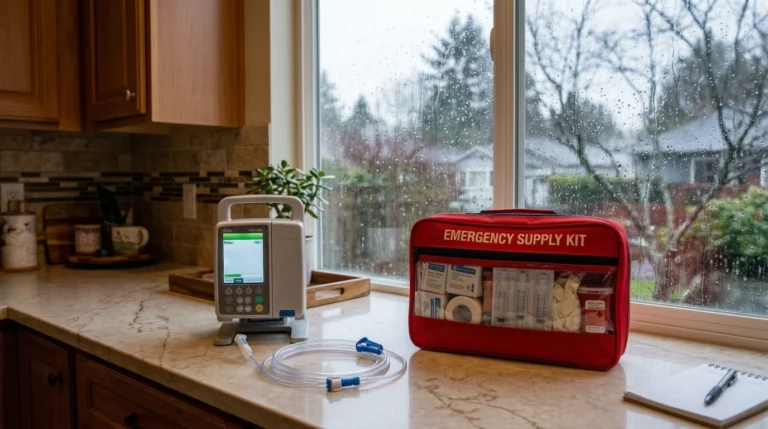
Hurricane and outage season doesn’t just threaten roofs and power lines. For home infusion providers, it threatens continuity of care. When a storm knocks out power or floods a region, patients relying on infusion pumps and other durable medical equipment (DME) can’t simply wait it out. Their equipment has to keep working, or a backup plan has to kick in immediately.
For home infusion providers and specialty pharmacies, hurricane and outage preparedness isn’t a once-a-year checklist; it’s an operational discipline. Here’s how to get your equipment, your team, and your patients ready before the first storm watch is issued.
Know Where Your Backup Devices Are Before You Need Them
When a hurricane is approaching, the worst time to discover a backup pump is missing, uncalibrated, or sitting in the wrong warehouse is the day you need to dispatch it. Every home infusion provider should maintain a clear, real-time picture of:
- How many backup devices are available
- Where each backup unit is physically located right now
- Which units are clean, calibrated, and ready to deploy versus which are out for service
Static spreadsheets and sticky notes on a whiteboard fall apart fast in an emergency, especially when multiple team members are trying to coordinate at once. A centralized, digital equipment record that’s updated automatically as devices move means your team can find out if they have a backup pump available for a patient in seconds, not hours.
Treat Batteries as Critical Infrastructure, Not an Afterthought
Backup power is a critical potential point of failure during an extended outage. A pump is only as reliable as its power source, and outage season puts batteries under real stress: extended runtimes, high-temperature storage conditions, and delayed charging opportunities if staff can’t get to a patient’s home right away.
Before hurricane season ramps up, build in a battery readiness routine:
- Test and log battery health on every device in rotation, not just the ones scheduled for use
- Confirm the expected runtime matches manufacturer specs; batteries degrade over time
- Stock charged spare batteries at multiple locations, not just one central depot, in case roads become impassable
- Log any device with a battery approaching end-of-life so it can be serviced or retired before, not during, a storm
Documenting battery status alongside each device’s maintenance history gives your team an honest picture of what’s actually storm-ready.

Don’t Overlook Temperature-Sensitive Inventory
Pumps and batteries aren’t the only assets at risk when the power goes out; refrigerated medications and biologics are just as vulnerable, and a refrigeration failure can expose medications to temperatures outside their labeled storage conditions, requiring product-specific assessment. This is why InfuseTrack partners with temperature monitoring providers like TempStick and SmartSense to give operators an early warning system for exactly this scenario.
SmartSense is our recommendation specifically for hurricane and outage season. SmartSense’s gateways run on an LTE cellular connection and are battery-backed, so sensor readings continue to be captured and stored even if power or the local network goes down, then sync automatically once connectivity is restored. SmartSense’s independence from local Wi-Fi and grid power is what makes it a recommended choice for when a storm actually knocks both out.
TempStick connects over standard Wi-Fi and is designed to run for a year or more on two AA batteries, a great fit for day-to-day monitoring, but still dependent on the building’s own internet connection to send alerts.
Pairing equipment tracking with a monitoring system means you’ll know about a refrigerator outage the moment it happens, not when someone opens the door the next morning.
Map Patient Assignments to Equipment in Real Time
In a disaster scenario, your team needs to answer two questions almost instantly: which patients are on infusion therapy that can’t be interrupted, and what equipment is currently assigned to them. This is where equipment tracking and patient care directly intersect.
A strong patient-assignment workflow should let your team:
- Pull a list of all patients currently using company-owned equipment
- See exactly which device (by serial number) is assigned to which patient and where that patient is located
- Identify patients in evacuation zones or areas expected to lose power first, so outreach can be prioritized
When equipment assignment records are accurate and current, your clinical and logistics teams aren’t relying on memory or fragmented notes to figure out who needs a check-in call first.

Keep Emergency Contact Information Current — For Patients and Staff
FEMA’s official guidance recommends that anyone dependent on power-reliant medical equipment work out a power outage plan with their provider in advance, including how long refrigerated medications can safely be stored at higher temperatures. That guidance applies just as directly to the providers supplying the equipment as it does to the patients using it.
Contact information is often the most neglected data field until it’s needed most. Before hurricane season, audit and refresh:
- Primary and secondary phone numbers for every active patient, along with a designated emergency contact or caregiver
- Preferred contact method if cell towers are down (some patients may only be reachable via a landline or a neighbor)
- After-hours and on-call contact information for your clinical staff, delivery drivers, and technicians
- A clear internal escalation path: who calls whom if a patient can’t be reached, and by when
FEMA recommends keeping a written list of phone numbers for medical providers and other essential services on hand, since cell networks and internet access are often the first casualties of a major storm.
This information should live somewhere your team can access even if the office itself loses power or internet, whether that’s a cloud-based system accessible from a mobile device or a printed backup list stored off-site.
Build a Rapid Equipment-Location Workflow
When a storm is imminent or has just passed, speed matters. Your team may need to relocate equipment ahead of an evacuation, redirect a backup pump to a patient whose device failed, or simply confirm that equipment in a flooded facility is accounted for. A rapid-location workflow should let staff:
- Search for any piece of equipment by patient name, serial number, or device type and get an immediate location result
- See equipment status (in use, in transit, in for maintenance, available) without calling multiple locations to piece it together
- Update a device’s location and status in the field so the whole team sees changes in real time, not after the fact
This is exactly the kind of visibility that manual tracking methods struggle to provide under pressure, and exactly where a purpose-built equipment tracking system earns its keep.
Preparedness Is a System, Not a Scramble
Hurricane and outage season will always bring uncertainty, but how your equipment, batteries, patient assignments, and contact information are managed shouldn’t be part of it. Providers who enter storm season with accurate, real-time equipment data can act in minutes rather than hours when it matters most.
InfuseTrack helps infusion centers, home infusion providers, specialty pharmacies, and hospital outpatient departments maintain exactly this kind of visibility: tracking every device, its location, its maintenance status, and its patient assignment in one place, accessible from anywhere. When the next storm warning goes out, your team shouldn’t be searching for answers. They should already have them.
Want to see how InfuseTrack can strengthen your emergency preparedness plan? Contact us to learn more.
Sources
- Centers for Medicare & Medicaid Services, “Core EP Rule Elements”
- U.S. Food and Drug Administration, “FDA Offers Tips About Medical Devices and Natural Disasters.”
- U.S. Food and Drug Administration, “Safe Drug Use After a Natural Disaster.”
- Administration for Strategic Preparedness and Response, “HHS emPOWER Map.”
- SmartSense by Digi, “SmartSense BZ Gateway” and “BZ Gateway Datasheet.”
- Ideal Sciences, “Temp Stick WiFi Temperature & Humidity Sensor.”
- Federal Emergency Management Agency, Ready.gov, “Power Outages.”
- Federal Communications Commission and FEMA, “Emergency Communications Tips.”
Images: Adobe Stock